Mary Cavendish
The Mysterious Affair at StylesMary Cavendish is John Cavendish’s wife, whose stillness and reserve conceal a forceful will and a consuming jealousy. Her private attempt to obtain a paper from Emily Inglethorp’s room makes her a central figure in the investigation: she did enter the room and drug Emily and Cynthia, but Poirot’s reconstruction distinguishes that dangerous act from the strychnine murder. Her story turns on the difference between what she meant to do and what she feared she had done.
Identity and First Impression
When Arthur Hastings first meets Mary at Styles Court, John introduces her as his wife. Hastings recalls her as tall and slender, with striking tawny eyes and an outward composure that seemed to contain an untamed spirit. She welcomes him in a low, clear voice, offers him tea, and listens attentively as he recounts his experiences at a convalescent home. The scene establishes the contrast that will shape her role: outward courtesy and stillness alongside a powerful, difficult-to-read inner life.
Mary’s reserve does not make her passive. In the later account of the investigation, Poirot describes her as resolute beneath her self-command, and the plot reveals how far she will go when jealousy takes hold. The distance between Hastings’s first impression of a fascinating, composed hostess and the woman who secretly enters a locked bedroom is not a simple reversal of character; it is the disclosure of an intensity that the initial portrait already suggests but cannot explain.
Marriage and Suspicion
Hastings notices what he calls Mary’s extraordinary preference for Dr. Bauerstein. She repeatedly invites him to Styles and goes on long excursions with him, though Hastings cannot understand the attraction. This is Hastings’s observation, not proof of an affair, and it supplies a counterpoint to the later jealousy that Poirot attributes to Mary: the early account records suspicion around her associations, while the eventual explanation places her own anxious attention on John’s fidelity.
On the afternoon before Emily’s death, Mary asks Emily for a paper and presses her to show it to her. Hastings overhears the brief exchange from the open boudoir window as he passes on his way to the tennis court. The fragment leaves the paper’s significance unresolved at the time; later, Poirot connects it to a note Mary believed would prove John’s infidelity. The concealed object gives the marital tension a material focus: Mary is not merely suspicious in the abstract, but determined to possess a piece of evidence she thinks will settle the question.
The Paper and the Bedroom
Poirot’s reconstruction begins with Emily’s movements in the boudoir. He believes she went looking for stamps, tried keys in her husband’s locked desk, and found a slip of paper that was not meant for her. Mary, according to Poirot, believed this was written proof of John’s unfaithfulness. Emily told her that it had nothing to do with the matter, but Mary thought Emily was protecting her stepson and continued to demand the paper. Poirot stresses that this explanation of Mary’s belief is his inference; the investigation does not present the supposed proof of infidelity as established fact.
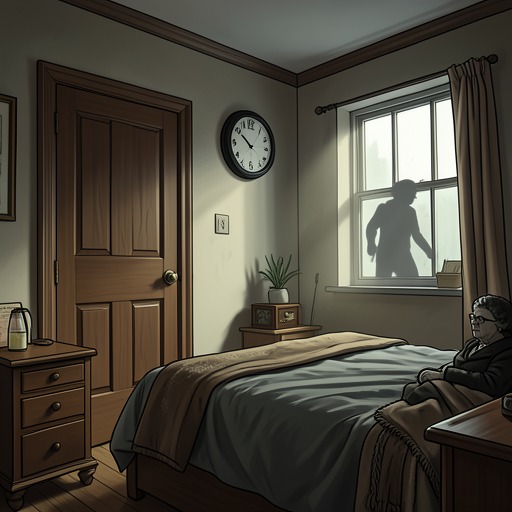
The opportunity to search Emily’s papers arose when Mary found the key to Emily’s despatch-case, which had been lost that morning. Knowing that Emily kept important documents there, Mary planned to enter her room. She unbolted the communicating door to Cynthia’s room, possibly quieting its hinges with oil, and waited until the early hours, when servants were accustomed to hearing her move about. Dressed in her land kit, she passed through Cynthia’s room into Emily’s. A fragment of green material caught in the bolt was identified as a piece torn from Mary’s land armlet; Poirot also tested her claim that she had heard the bedside table fall from her own room. Together, the fragment and the test supported his account of her route into the bedroom.
At the inquest, Mary gave her account in a low, composed voice. Her alarm clock woke her at 4:30, as usual; while dressing, she heard something heavy fall, then heard the bell ring violently. She said that she listened, and that Dorcas ran downstairs and woke John before the household went to Emily’s locked room. Her testimony became a point of comparison for Poirot’s reconstruction, rather than a complete account of what she herself had done in the night.
The Drugging and Its Consequences
Mary’s secret purpose was to get the paper, but her actions had a separate and grave consequence. Poirot explains that she administered a narcotic to both Emily and Cynthia. The analyst’s report had tested for strychnine, not for a narcotic; Poirot’s additional test disclosed the sedative. He concludes that Mary believed the draught harmless, but when Emily became ill and the word poison was heard, Mary feared that her own act had caused the death. In her panic, she dropped Cynthia’s coffee cup and saucer into a large brass vase. The remains of the cocoa were left untouched, because too many people were watching.
That panic also helps explain why Mary’s conduct could look incriminating while pointing to a different crime. The poisoning that killed Emily was strychnine poisoning: the post-mortem estimate was at least three-quarters of a grain, probably one grain or slightly more. Poirot’s explanation is that the narcotic Mary administered alongside the strychnine delayed the poison’s effects for hours. The narcotic accounts for the delay and for Mary’s fear; it does not make her the person who administered the lethal strychnine.
When Poirot lays out the explanation, Mary looks up and confirms that it is true, calling it the most awful hour of her life. She also recognizes what Poirot had meant when he told her she could safely confess to him. Her admission clarifies both her guilt and its limits: she had secretly drugged Emily and Cynthia in pursuit of the paper, but the murder was not the consequence she intended or the poisoning she carried out.
Inheritance and the Case’s Reversals
Mary’s situation unfolds amid disputed expectations about the family fortune. At the inquest, John says Emily’s will from the previous August left her entire fortune to him, after minor legacies to servants. He explains that Lawrence would receive a considerable sum under their father’s will when Emily died, while John inherited the property and had to maintain Styles. Poirot points out that Emily’s remarriage automatically revoked the earlier will. This legal complication, and the later discovery that a destroyed new will favored Alfred, made inheritance an unstable source of suspicion rather than a settled account of motive.
At John’s trial, the prosecution presents him as a spendthrift whose stepmother had supported him, alleges that she confronted him over an intrigue, and argues that he disguised himself as Alfred to buy strychnine. The defence counters that the alleged purchase was a false identification and that John had been elsewhere; it also stresses that he knew the old will had been revoked by Emily’s remarriage. Evidence such as the chemist’s identification and the blotting-paper impression of a will favoring Alfred complicates the accusation. These courtroom arguments do not establish Mary’s role, but they show how competing readings of family loyalty, money, and concealed actions place her private jealousy within a larger field of misleading appearances.
Mary’s narrative importance lies in that distinction between appearance, evidence, and intention. Her self-command initially makes her difficult to read; her testimony and the green fragment connect her to Emily’s room; and the discovered narcotic explains conduct that could otherwise collapse into a false confession to murder. The resolution neither erases the danger of her choices nor equates them with the killing. It makes her confession the point at which the investigation separates a desperate search for proof from the strychnine crime that she feared she had caused.